
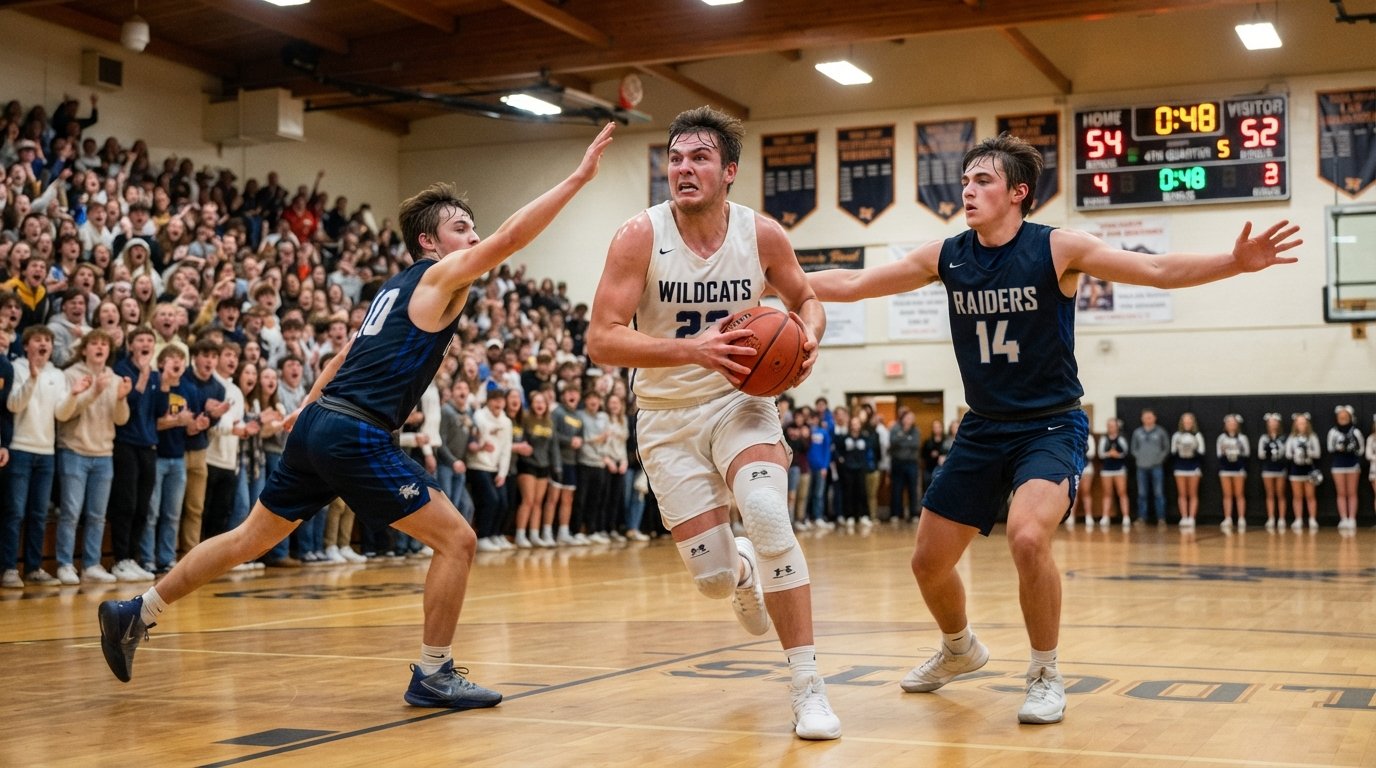
If you’re heading to a high school basketball game for the first time — or you’re a parent trying to figure out when to pick up your kid — the first question that comes to mind is usually a simple one: how long are high school basketball games, exactly? The straightforward answer is that a standard game under National Federation of State High School Associations (NFHS) rules has 32 minutes of regulation playing time, split across four eight-minute quarters. But here’s the thing — the clock on the scoreboard and the clock on your phone are two very different things when you’re sitting in those bleachers.
The real-world time you’ll spend at the gym is considerably longer than 32 minutes. Timeouts, fouls, free throws, halftime, quarter breaks, and the occasional injury stoppage all add up fast. And if the game goes to overtime? Plan accordingly. This article breaks down exactly how high school basketball game length works — from the official rules to what you should actually expect when you walk through those gym doors.
How Many Quarters in High School Basketball — and How Long Is Each One?
Under NFHS rules, a regulation high school basketball game is divided into four quarters, each eight minutes long. That’s where the 32-minute total comes from. It’s clean, simple math — but only on paper.
In practice, those eight minutes stretch considerably. The game clock in basketball stops frequently. Every time a referee blows the whistle — for a foul, a timeout, a ball going out of bounds, a free throw attempt — the clock stops. That’s just the nature of the sport. An eight-minute quarter at the high school level can easily take 20 to 25 real-world minutes to play out, depending on how physical the game gets and how many timeouts are burned.
Anyone who’s sat through a tight fourth quarter late in a season game knows exactly what that feels like. The last two minutes alone can drag on for what seems like forever when both teams are in the bonus and every possession ends with a trip to the free throw line.
High School Basketball Halftime Length and Quarter Intermissions
Between the first and second quarters, and again between the third and fourth quarters, NFHS timing regulations specify a one-minute intermission. These are short breaks — just enough time for players to catch their breath and coaches to make quick adjustments. They don’t add much to your total time at the gym.
Halftime is a different story. The NFHS timing guidelines set halftime at 10 minutes, though it can be extended to a maximum of 15 minutes under certain conditions. Most high school programs stick close to 10 minutes, but local scheduling, pep band performances, or other halftime activities can sometimes stretch it a bit. If your school’s program is running a halftime show or a community recognition ceremony, expect to sit for closer to 15 minutes.
So when you add it all up — four quarters of stop-and-start action, two one-minute intermissions, and a 10-minute halftime — you’re already well past the 32 minutes of scheduled playing time before you account for a single timeout.
Timeouts, Fouls, and Other Stoppages That Affect High School Basketball Game Length
This is where a lot of people — especially newer fans — get caught off guard. The 32 minutes of regulation time is the scheduled playing time. It’s not a prediction of how long you’ll be sitting in the gym.
Every timeout stops the clock. Under NFHS rules, teams have a set number of timeouts available during a game, and coaches use them strategically — to set up plays, stop an opponent’s run, or give a player a breather. Each timeout represents another pause in the action.
Fouls are the biggest time-extenders of all. When a player is fouled, the clock stops. Then the player has to walk to the free throw line, set up, shoot, and potentially repeat that process two or three times. Multiply that by a full game where both teams are playing physically, and you can add a substantial chunk of time to the evening.
Jump balls, injuries, official reviews — they all factor in. The NFHS timing regulations address these situations specifically, providing guidance for officials on how to handle clock malfunctions and timing errors, which is something the 2026-27 rule updates reinforced explicitly. The bottom line is that the game clock and the wall clock are always going to tell different stories.
High School Basketball Overtime Rules — What Happens When the Game Is Tied
Tied after four quarters? Then you’re heading to overtime. Under NFHS rules, overtime periods are four minutes long. If the game is still tied after the first overtime, another four-minute period is played. This continues — with additional four-minute periods — until one team comes out ahead.
There’s no sudden-death, first-basket-wins format at the high school level. Each overtime period plays out fully, with the same clock-stopping rules that apply during regulation. That means an overtime period can easily take 10 to 15 real minutes to complete, sometimes more.
If you’ve ever watched a double-overtime high school game on a Tuesday night, you know that what started as a 7:00 p.m. tip-off can still have you in the gym past 9:30. It doesn’t happen every night, but it happens — and it’s worth knowing going in.
How Long Does a High School Basketball Game Last in Real Time?
Honestly, there’s no single right answer here, and anyone who gives you a specific number without qualification is guessing. What can be said with confidence is that a typical high school basketball game — factoring in stoppages, intermissions, halftime, and timeouts — generally runs between one and a half to two hours for the event as a whole. But that range shifts based on how the game flows.
A fast-paced game with few fouls and teams that don’t call many timeouts can move along relatively quickly. A grinding, physical game in the fourth quarter of a rivalry matchup? That’s a different experience entirely. Add overtime to the equation and you’re looking at a longer night.
The key distinction — and it’s worth repeating — is the difference between scheduled playing time and total event time. Thirty-two minutes is how long the clock is supposed to run during regulation. It is not how long you’ll be at the gym. Plan for two hours as a reasonable baseline, and give yourself flexibility if the game is close late.
Do All States Follow the Same Rules?
Mostly, but not always. The NFHS provides the national framework that the vast majority of state high school athletic associations adopt. Most states follow the four-quarter, eight-minutes-per-quarter format. But state associations do have the authority to adjust or modify rules for their specific competitions, and some do.
Tournament settings, postseason play, and certain invitational events may have their own scheduling and timing considerations as well. If you’re trying to plan around a specific game — especially a state tournament contest or a high-stakes regional event — it’s worth checking directly with your state’s high school athletic association. They’ll have the official rules and any modifications in place for that competition.
The NFHS basketball rules, including timing-related updates for the 2026-27 season, are publicly available at nfhs.org. That’s your most reliable source if you need to dig into the specifics.
What’s New in the 2026-27 NFHS Basketball Timing Rules
The NFHS rolled out a couple of notable timing-related updates for the 2026-27 season that are worth knowing about. One involves late-quarter throw-in situations — specifically, a requirement that at least 0.3 seconds must expire from the game clock for certain basket-scoring plays on throw-ins in the final seconds of a period. This is designed to add clarity and consistency in situations where fractions of a second can determine whether a shot counts.
The 2026-27 rules also include updated guidance for officials dealing with clock malfunctions or timing errors — situations that, while rare, can create real confusion during a game. These updates were announced by the NFHS in May 2026 and are part of an ongoing effort to support officials in managing game timing accurately and fairly.
These aren’t sweeping changes to the overall structure of the game — four quarters, eight minutes each, four-minute overtime periods — but they reflect the kind of careful, practical rule maintenance that keeps the game running smoothly at the high school level.
Frequently Asked Questions
How long is a high school basketball game compared to an NBA or college game?
High school basketball games are shorter in scheduled playing time than both NBA and NCAA games. NBA games consist of four 12-minute quarters (48 minutes total). NCAA college games use two 20-minute halves (40 minutes total). High school games under NFHS rules run four eight-minute quarters for 32 minutes of regulation play. All three formats involve clock stoppages that extend real-world game length beyond those scheduled totals.
Can a high school basketball game end in a tie?
No. Under NFHS rules, ties are broken with overtime. After a regulation game ends tied, a four-minute overtime period is played. If the teams remain tied after that period, another four-minute overtime follows. The process continues until one team leads at the end of an overtime period. There’s no tie outcome in high school basketball — somebody wins.
How many timeouts do high school basketball teams get during a game?
Under NFHS rules, each team is allowed five timeouts per game during regulation. Three of those are full timeouts (one minute each) and two are 30-second timeouts, though specific timeout structures can vary slightly by state. Additional timeouts may be granted in overtime periods. Since timeouts stop the clock, they’re one of the primary reasons actual game time runs well beyond 32 minutes.
How long is halftime in high school basketball?
Under NFHS timing regulations, halftime is 10 minutes. It can be extended to a maximum of 15 minutes under certain conditions. Most high school programs operate close to the 10-minute standard, though local scheduling or halftime activities — a band performance, a senior recognition ceremony — can occasionally push it toward that 15-minute ceiling.
Does high school basketball game length change during tournaments or playoffs?
The standard NFHS format — four eight-minute quarters — generally applies in postseason play, but state associations can make modifications for tournament settings. If you’re attending a state playoff game or a major invitational tournament, it’s a good idea to check directly with your state’s high school athletic association or the tournament host for any scheduling or timing specifics. Don’t assume tournament timing is identical to a regular-season game.
FAQ Schema Recommendation: Mark this FAQ section up with FAQ Schema (JSON-LD) to improve eligibility for Google FAQ rich results.
One Last Thing Worth Knowing
If someone asks you how long high school basketball games are, the honest answer is: 32 minutes on the clock, and considerably longer in the gym. Knowing that difference — and planning around it — makes the whole experience better, whether you’re a parent figuring out pickup time or a fan deciding whether to grab dinner before the tip-off. When exact timing matters, your state athletic association always has the final word on high school basketball game length rules in your area.