
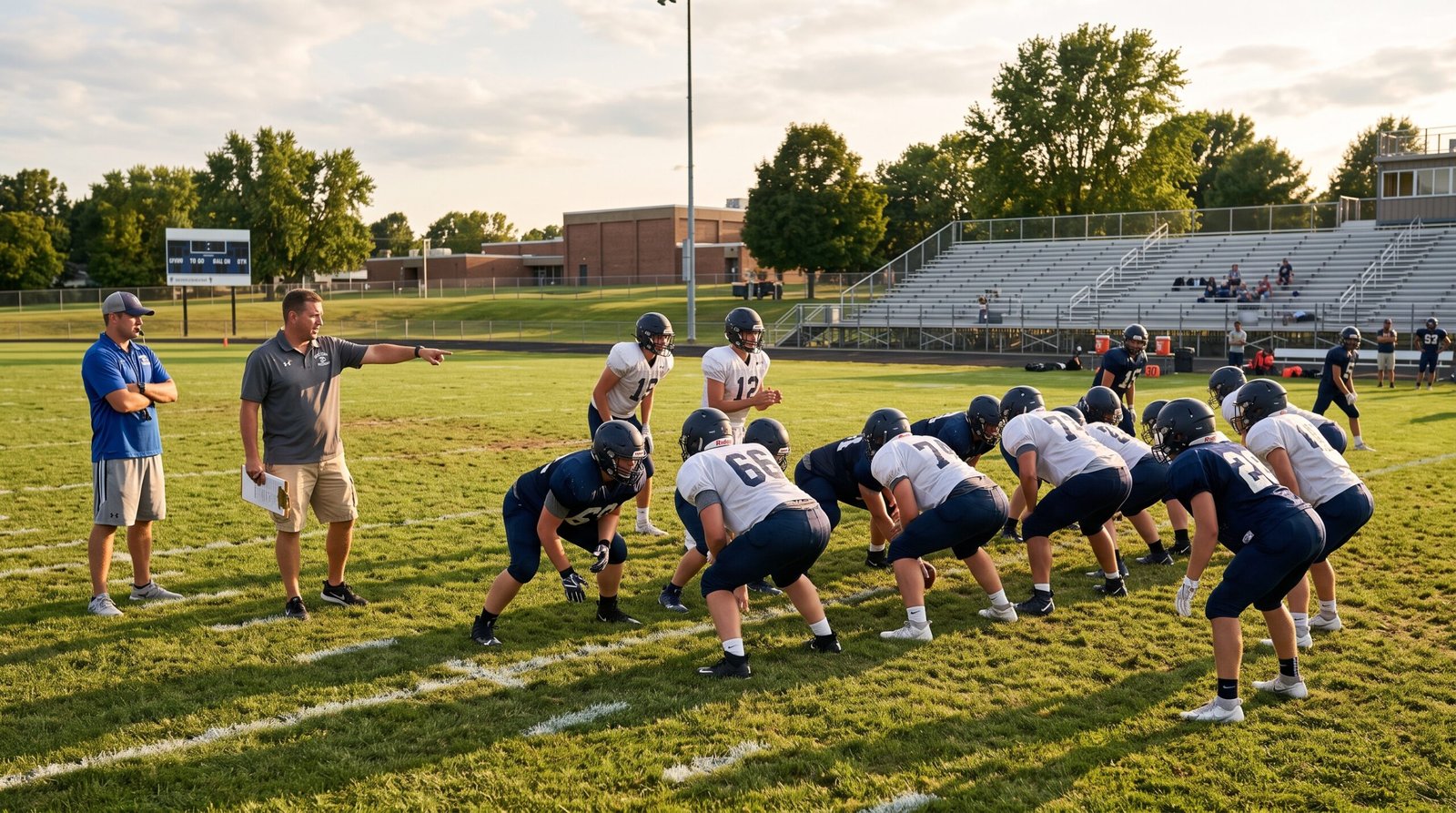
Walk past any high school practice field in early August and you’ll already find players in helmets and shoulder pads, running drills in the summer heat. The season hasn’t officially started yet, but football is already underway. So how long does the high school football season last? The honest answer: it depends on the state and how far a team advances. For most programs, the full calendar—from the first practice to the last game—runs roughly four to five months, stretching from late summer through fall and, for playoff teams, into December. A team eliminated after the regular season wraps up much earlier than one playing for a state championship in mid-December.
There’s no single national start date or end date. Each state’s athletic association sets its own football calendar, which means a program in Texas operates on a different schedule than one in Ohio, Florida, or anywhere else. Here’s how the season is typically structured, and what to expect at each stage.
The Season Timeline: From First Practice to Final Whistle
High school football unfolds in three distinct phases: the preseason, the regular season, and the postseason. Understanding all three explains why the season can last anywhere from about two and a half months for a team with no playoff run to nearly five months for one that reaches a state title game.
Preseason: Conditioning, Practices, and Scrimmages
Before any official game is played, teams go through a preseason period that includes conditioning, full-contact practices, and scrimmages. Scrimmages are informal game-like sessions against other schools—they don’t count in the official standings, but they give coaches a look at their roster before the real games begin.
In Texas, for example, the University Interscholastic League (UIL)—which governs high school athletics in that state—allows certain schools to begin conditioning as early as August 3 for the 2026-27 season, with full-contact practice beginning August 8 and scrimmages beginning August 13. Ohio’s schedule, governed by the Ohio High School Athletic Association (OHSAA), has practice starting August 1 for the 2026 season.
These preseason weeks matter a lot. Players spend them installing offensive and defensive schemes, building conditioning, and competing for starting spots. It’s also when student-athletes have to manage the reality of two-a-day practices alongside the start of the school year—which requires energy management that coaches and parents know well.
The Regular Season: Friday Nights and the Race for Playoffs
Once the regular season begins, most teams play once a week—almost always on Friday nights. That weekly rhythm gives coaches several days between games to review film, adjust their game plan, and manage player recovery.
In Texas, the UIL’s 2026-27 calendar gives certain schools 11 weeks to complete a maximum of 10 regular-season games. Ohio’s regular season begins the week of August 17 and runs through October 25, 2026. Those are two concrete examples—but they’re not the national rule. Game limits, scheduling windows, and start dates all depend on local athletic association guidelines.
Some states may play fewer regular-season games. Others may schedule more. Schools in different classifications within the same state can also operate on slightly different timelines. The number of games a team actually plays doesn’t always equal the maximum allowed—scheduling conflicts, cancellations, or early-season byes can reduce the total.
When Does High School Football Season End?
This is where things vary the most. A team that doesn’t qualify for the playoffs finishes when its regular season ends. In Ohio, that’s late October. In Texas, it could be the first week of November, depending on the classification. For those programs, the season is done, the pads go away, and seniors play their final high school game before Thanksgiving.
Playoff football changes the timeline entirely.
Teams that qualify for postseason play keep going. The playoffs are a bracket-style tournament where teams are eliminated until one remains as state champion. Advancing one round means one more week of practice and one more game. Advance far enough, and you’re playing deep into November—or December.
Texas provides a clear example of how long a deep playoff run can last. According to the UIL’s football calendar, the 2026-27 state championships are scheduled for the week of December 16–19. A Texas team that starts conditioning August 3 and reaches the state championship game in December is looking at a football calendar of roughly four and a half months.
Ohio’s state championships are scheduled for December 3–5, 2026, according to the OHSAA’s official calendar. With practice beginning August 1, a team playing in that championship is also covering close to four months of football.
For the families and players involved in a long playoff run, the calendar impact is real. Thanksgiving plans shift. December weekends get consumed by away game travel. Senior players—especially those who aren’t continuing to play at the next level—experience the weight of knowing each remaining game could be their last.
How Many Games Does a High School Team Play?
The number of games varies, and it’s important to separate official regular-season games from scrimmages and playoff games.
Scrimmages happen before the regular season and don’t count toward the standings. Regular-season games are the official contests that determine playoff qualification. Playoff games are the postseason rounds that follow.
A team that plays a full regular season and loses in the first round of the playoffs will play more total games than a team that finishes the regular season at the same time but misses the playoffs entirely. A team that runs the table and wins a state title plays the most games of any program in its state that year.
Because game limits are set by state associations—not a single national body—there’s no universal answer for how many games every high school team plays in a season. What’s accurate is that regular-season game limits, scrimmage allowances, and playoff rounds all vary by state.
Why the Season Looks Different Depending on Where You Live
The National Federation of State High School Associations (NFHS) maintains the national football rules framework—the rulebook that covers gameplay, officiating, and safety standards. But the NFHS doesn’t dictate when practice starts, how many games a team plays, or when the postseason ends. Those decisions belong to each state’s high school athletic association.
That structure is why the Ohio and Texas calendars look different from each other, and why a school in Florida—governed by the Florida High School Athletic Association (FHSAA)—may operate on a different timeline than both. Within a state, schools in different classifications can also face slightly varied windows for scheduling and postseason play.
It also means that even neighboring schools in the same district can finish their seasons at different times if one advances in the playoffs and the other doesn’t.
The Full Program Calendar vs. Games Played
It’s worth drawing a clear line between the length of the football program calendar and the number of games a team actually plays. The calendar—from the first conditioning session to a potential state championship—can span four to five months. But a team with a 10-game regular season and a first-round playoff exit might play 11 total games across roughly 11 or 12 weeks of competition.
The calendar is longer than it looks on paper because weeks include practices, film sessions, travel to away games, and recovery days—not just game days. For student-athletes, that’s a significant commitment on top of regular coursework, and it continues well into the fall semester for teams making playoff runs.
Parents planning around the football schedule often discover this gap between “the season” and “the full program calendar” when October rolls around and there are still games left to play.
A Quick Recap: Season Length by Phase
- Preseason (conditioning, practices, scrimmages): Typically begins in late July or early August, depending on the state.
- Regular season: Usually starts in August or September and runs through October or early November, depending on the state and classification.
- Postseason (playoffs and state championships): Extends into November for early rounds; state championship games in states like Texas and Ohio are scheduled as late as mid-December.
- Non-playoff teams: Finish when the regular season ends—often in October or early November.
Note: Specific start and end dates vary by state, classification, and season. Always check your state athletic association’s official calendar or your school’s athletic department for accurate, current scheduling information.
Frequently Asked Questions
When does high school football season start?
Preseason conditioning and practice typically begin in late July or early August, depending on the state. Official regular-season games usually start in August or September. For example, Ohio’s 2026 season begins the week of August 17, while Texas UIL conditioning for 2026-27 starts as early as August 3 for certain schools. Start dates are set by each state’s athletic association, not a national authority.
When does high school football season end?
It depends on how far a team advances. Programs that don’t qualify for the playoffs finish when their regular season ends—often in October or early November. Teams in the playoffs continue into November. Those reaching a state championship game can play as late as mid-December. Texas UIL’s 2026-27 state championships are scheduled for the week of December 16–19, and Ohio’s are set for December 3–5, 2026.
How many games do high school football teams play in a season?
The number varies by state and postseason advancement. Texas UIL gives certain schools 11 weeks to play a maximum of 10 regular-season games. Teams that qualify for the playoffs play additional games beyond the regular season. There is no single national game limit—state athletic associations set those guidelines individually, and actual totals depend on scheduling and how deep a team goes in the postseason.
Do all high school football teams play into December?
No. Only teams that advance deep into the state playoffs play in December. Most programs that don’t qualify for postseason play finish in October or early November. Even among playoff teams, many are eliminated in early rounds and finish before December. A December game means a team has survived multiple playoff rounds and is competing for a state title.
Is the high school football season the same length in every state?
No. Each state’s athletic association establishes its own football calendar, including practice start dates, regular-season schedules, game limits, playoff structures, and championship dates. The NFHS provides the national rules framework for gameplay, but individual states control the season calendar. Readers should check their state athletic association’s official website for accurate, current information.
FAQ Schema Recommendation: Mark this FAQ section up with appropriate structured data (FAQPage schema) where eligible and supported by current Google guidelines.
The high school football season doesn’t have one start date, one end date, or one fixed length that applies everywhere. What’s consistent is the structure—preseason preparation, a regular season of weekly games, and a postseason for teams that earn it. For families and players trying to plan around the schedule, the best source is always the official calendar from your state’s athletic association or your school’s athletic department. The season moves fast once it starts, and knowing the full timeline from August through a potential December championship run helps everyone stay ahead of it.





[…] a four-hour evening. For the bigger picture of how all of this fits into the calendar — from the first practice of the season to the last game — the high school football season timeline on this site walks through it month by […]