
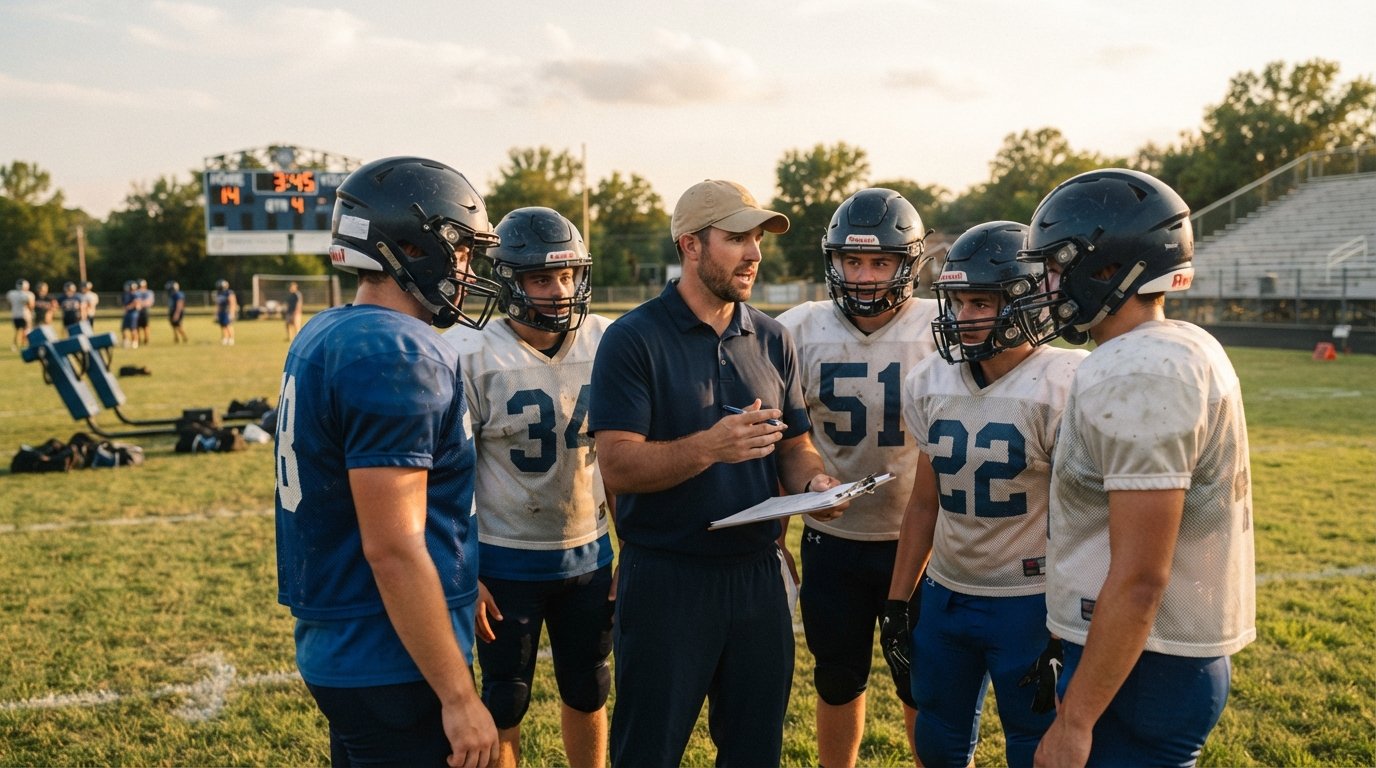
If you’ve spent years around the game and find yourself thinking, “I could do this,” you’re probably asking the right question at the right time. Figuring out how to become a high school football coach isn’t as complicated as some people make it sound — but it’s not as simple as just showing up and claiming a clipboard, either. There’s a real path here, and it starts with understanding that the requirements aren’t the same everywhere. What Texas asks of a coaching candidate isn’t necessarily what Ohio, California, or Georgia will require. State athletic associations set the rules, and individual school districts can layer on their own expectations beyond that. So before anything else, the most important thing you can do is reach out to your state’s high school athletic association and your target school or district directly.
That said, the general road into high school football coaching follows a recognizable pattern — and this article walks you through it honestly.
There Is No Single Nationwide Requirement
Here’s something a lot of people don’t realize at first: there is no universal, federally standardized checklist for becoming a high school football coach in the United States. Requirements vary significantly by state, school district, and even the specific position you’re going after.
The U.S. Bureau of Labor Statistics notes in its Occupational Outlook Handbook that coaches and scouts typically need a bachelor’s degree, though educational requirements can range from no formal credential to a bachelor’s degree or higher depending on the employer and the role. So while a four-year degree is common and often expected, it is not a universal hard requirement for every high school football coaching job in the country.
What this means practically: don’t assume anything. A coaching candidate who does their homework on the front end — contacting their state association, reading the actual hiring requirements of target schools — is going to be far better positioned than someone who assumes one state’s rules apply everywhere.
How to Become a High School Football Coach: The Realistic Path
Most coaches who end up running a program on Friday nights didn’t get there in one straight line. The path usually looks something like this.
Know the Game — Really Know It
Coaching starts with deep football knowledge. You need to understand offensive and defensive schemes, player development principles, game management, situational football, and how to put young athletes in positions to succeed. This doesn’t mean you had to play college or professional football — the BLS acknowledges that coaches often gain sport knowledge through playing experience, but playing background is not a universal requirement. Some excellent high school coaches never played past the recreational level. What matters is that you actually know the game and can teach it.
Watch film. Study playbooks. Attend clinics. Read. If you played at any level, that experience matters and gives you a frame of reference. But if you didn’t, genuine, focused learning can still get you where you want to go.
Get on a Sideline — Any Sideline
Practical experience is where things start to get real. Youth leagues, middle school programs, junior varsity staffs — these are the entry points. Volunteering as an assistant, helping with summer camps, working with a local Pop Warner team: all of it counts. Coaches who eventually get hired at the high school level almost always have some kind of hands-on coaching background behind them, even if it’s informal at first.
And honestly, there’s no substitute for it. You can study X’s and O’s all you want, but the moment you’re trying to explain a blocking assignment to a nervous 15-year-old while the clock is running, you realize pretty quickly that coaching is a communication skill as much as it is a football skill. When you consider that millions of student-athletes play high school football across the country, the demand for capable, well-prepared coaches at every level of a program is very real.
Complete Required Education and Certifications
This is where state-specific requirements become critically important. Public high school coaches in many states may need to complete mandatory coaching education courses, and some states have specific certification programs that must be completed before you can be hired. Texas, for example, has a Coaches Certification Program with required training components — which is a useful illustration of why you can’t assume your state works the same way as another.
The NFHS Learning Center is a resource worth knowing about regardless of where you live. The National Federation of State High School Associations offers a three-level National Coaching Credential for people currently coaching or aspiring to coach at the interscholastic level. The NFHS also offers its Fundamentals of Coaching course, which was introduced in January 2007 and has since become a primary component of new-coach training in most NFHS-member state associations. An updated version of that course was published by the NFHS Learning Center in 2024.
But — and this is worth emphasizing — don’t assume a particular NFHS course is mandatory in your state just because it’s commonly used. Some states require it. Others don’t. Check with your actual state association before enrolling in anything under the assumption that it satisfies a specific requirement. Completing a course or earning a credential is valuable regardless, but it doesn’t guarantee employment, and it may or may not satisfy your state’s specific mandate.
Additional requirements that some states or school districts include: CPR and first-aid certification, background checks, and concussion awareness training. These are common enough that it’s reasonable to pursue them proactively — but again, verify what your specific state or district requires.
Build a Coaching Résumé
Schools don’t just hire warm bodies to coach football. They want people with a track record, even at entry-level positions. Your résumé should reflect any coaching experience you’ve accumulated, the level you coached at, what role you filled, and any relevant training or credentials you’ve completed.
Letters of recommendation from coaches, athletic directors, or school administrators carry real weight. If you’ve been a volunteer assistant at a youth program and the head coach there speaks highly of you, that relationship matters. High school athletics — at every level — run partly on trust and reputation within the local coaching community.
Assistant Coach First, Then Head Coach
Most people who eventually become high school head coaches started as assistants. That’s not a knock on anyone — it’s just how the job works. Assistant coaching positions are where you learn how a program operates day to day: practice planning, film study, game preparation, relationships with players and parents, off-season program management, and all the administrative pieces that never show up on a highlight reel.
Becoming a strong assistant makes you a more credible head-coaching candidate down the road. Athletic directors and school administrators want to hire head coaches who’ve demonstrated they can handle responsibility, communicate well with young athletes, manage difficult conversations with parents, and contribute to a program culture that reflects the school’s values.
Head-coaching jobs at the high school level are genuinely competitive. Schools receive multiple applicants for open positions, particularly at programs with strong traditions or in areas where football carries significant community weight. Having a history of assistant experience — ideally at the high school level — puts you in a meaningfully stronger position than someone with credentials alone.
High School Football Coach Requirements Beyond the X’s and O’s
Here’s something that gets overlooked in a lot of career-guide content about coaching: the job is as much about people as it is about football. High school coaching is fundamentally education-based. The NFHS specifically emphasizes student-centered coaching, sportsmanship, citizenship, and student development as core values in interscholastic athletics — and that philosophy is baked into how most states approach coaching education.
So what does a school actually want when they hire a football coach? They want someone who can teach the game, yes. But they also want someone who communicates clearly with 16- and 17-year-olds, who can handle a parent phone call professionally, who understands player safety and takes it seriously, and who helps build young people up — not just win games.
Organization matters enormously, too. Running a high school football program involves scheduling, budgeting, coordinating with administrators, managing a staff of assistants and a full roster of players, handling eligibility questions, and keeping everything together across a long season. Coaches who treat it like a job — because it is one — tend to stick around longer and run better programs.
Checking Your State’s Requirements
Before you apply anywhere, the smartest move is to go directly to your state’s high school athletic association and read the current coaching requirements. The NFHS Learning Center’s website includes a resource for coaches that can help point you toward state-specific information, and the BLS Occupational Outlook Handbook provides useful background on the broader coaching occupation.
Requirements can and do change. A course or credential that was optional in your state two years ago may be required today. A background check that wasn’t standard in a particular district may now be mandatory. Verifying with the relevant state association, school district, or hiring school before you apply — not after — is the professional move.
Readers are strongly encouraged to confirm current requirements directly with their state’s high school athletic association and the specific school district or institution they are applying to, as requirements can vary and change over time.
Frequently Asked Questions
Do you need a teaching degree to coach high school football?
Not always, though it depends heavily on the state and school. Many high school football coaching positions are filled by teachers or school administrators, which makes a teaching credential helpful or even expected in some districts. But schools may also hire qualified candidates from outside the school when appropriate. Check with your target school district and state athletic association for the actual requirement in your area.
Does playing high school or college football help you get a coaching job?
Playing experience can be valuable and gives you firsthand knowledge of the game, which many coaches and athletic directors appreciate. The BLS notes that coaches commonly gain sport knowledge through playing experience. That said, previous playing experience is not a universal requirement. Coaches who didn’t play at a high level can still build strong football knowledge through study, mentorship, and hands-on coaching experience.
What is the NFHS Fundamentals of Coaching course, and do I need it?
The Fundamentals of Coaching course is offered through the NFHS Learning Center and has become a primary component of new-coach training in most NFHS-member state associations since its introduction in 2007. An updated version was published in 2024. Whether it’s required in your state depends on your specific state association’s rules. It’s worth completing regardless, but verify with your state whether it satisfies a specific certification requirement before assuming it does.
How competitive are high school football coaching jobs?
It varies by school, program history, and region. Programs with strong community support and winning traditions tend to attract more applicants. Entry-level assistant positions are generally more accessible than head-coaching roles, and most coaches build toward a head job by gaining experience as an assistant first. Building relationships within your local coaching community and accumulating relevant experience makes a real difference in competitive hiring situations.
Can a high school football coach work part-time or is it a full-time job?
Many high school football coaching positions — particularly assistant roles — are part-time stipend positions, meaning coaches receive additional compensation on top of a primary salary, often a teaching salary. Head-coaching positions at larger programs may involve more responsibility and a higher stipend, but the structure varies by school and district. Some coaches hold full-time positions at a school and coach as part of their overall employment package. Verify compensation and expectations directly with the hiring school.
FAQ Schema Recommendation: Mark this FAQ section up with FAQ Schema (JSON-LD) to improve eligibility for Google FAQ rich results.
Closing Thought
Becoming a high school football coach takes preparation, patience, and a genuine commitment to something bigger than winning — and that last part isn’t just something coaches say for the camera. The best ones actually mean it. If you’re serious about learning how to become a high school football coach, start by contacting your state association, get on a sideline somewhere, and build from there. The path is real. It just requires doing the work before you ever draw up your first play.