Walk into any high school stadium on a Friday night and the scoreboard is doing something you have probably wondered about. The clock counts down, a horn blows, the number resets — four times, to be exact. That is the basic shape of the game: four quarters, two halves, a break in the middle.
The short answer to how many quarters are in a high school football game is four. Two in the first half, two in the second, with a 15-to-20-minute halftime between them. Under NFHS rules — the standard that most state athletic associations follow — varsity quarters run eight minutes of game clock each, for a total of 32 minutes of official playing time.
But here is the thing. The scoreboard clock and the clock on your wrist rarely agree. A 32-minute game usually takes close to two hours from first snap to final horn. And depending on your state — or whether the teams playing are varsity, junior varsity, or younger — those quarters might not be eight minutes at all.
The Basic Structure: Two Halves, Four Quarters
A varsity game follows the same skeleton as college and the NFL: four quarters grouped into two halves. Between quarters there is a short break — a couple of minutes in most states — just long enough to regroup, make a couple of quick calls, and line the next group up.
Halftime is the real break. NFHS rules set varsity halftime at 15 minutes, and both schools can agree to stretch it to 20. In practice, most programs schedule the full 20, because that is when the band takes the field, the mascots work the bleachers, and the players finally sit down and drink something. It is also the only break long enough for a coach to walk through a new game plan.
Eight minutes of game clock sounds short. It is not. A single quarter contains an entire offensive series, a defensive stand, a special teams sequence, and usually at least one timeout or two. Do the math over four of them, and you have a complete football game — just compressed into the shape of a high school Friday night.
How Many Quarters in a High School Football Game?
Four. Every varsity high school football game you will watch in the United States is played in four quarters. That is the universal part of the answer. No state plays old-style halves, and no varsity team gets a fifth quarter.
Where it gets complicated is length. Under NFHS rules — the standard most state athletic associations adopt — a varsity quarter is eight minutes of game clock. Four times eight gives you 32 minutes of official playing time — well short of a college game’s 60 minutes and far below the NFL’s 48, and the clock is the first place you notice that.
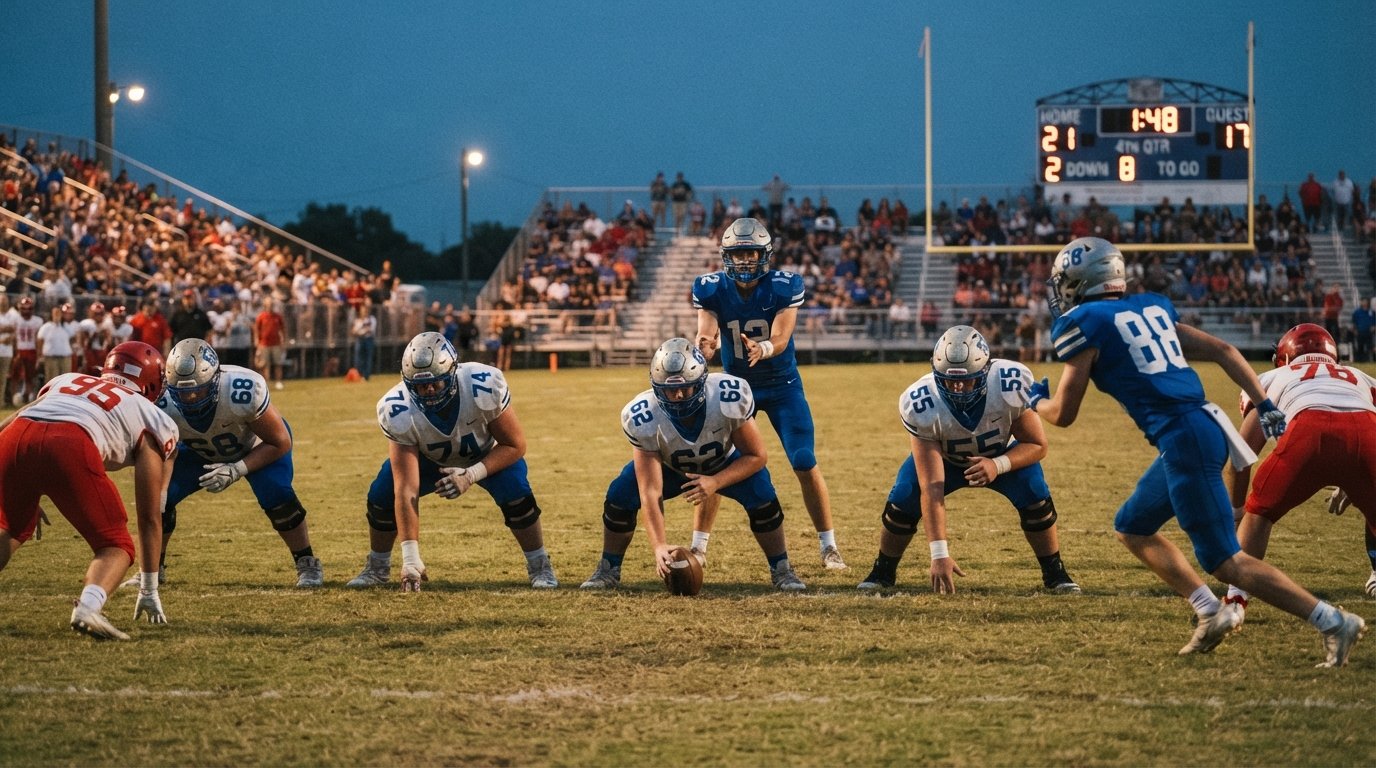
Here is where it stops being a trivia answer and starts being useful. Those 32 minutes on the scoreboard are not 32 minutes of your evening. The clock stops for incomplete passes, punts, the ball going out of bounds, penalties, injuries, and timeouts, and a team up late in the fourth will run a methodical, clock-killing game while a team chasing goes no-huddle. On a typical Friday night, expect the whole evening to run close to two hours.
And the quarters do not all feel the same. The first is usually the quickest on real time, because nobody has stopped the clock many times yet. The fourth is usually the longest — every timeout is spent, every delay adds up, and both teams are managing seconds instead of minutes.
Do JV and Younger Teams Play the Same Quarters?
No. State athletic associations set their own timing for sub-varsity levels, and that is where the real variation shows up. In Ohio, for example, the OHSAA’s modified rules set JV quarters at 10 minutes, ninth grade at nine, and seventh and eighth grade at eight. Same state, same field, three different clocks.
Other states go the other direction. Oregon’s state handbook, for instance, lists 12-minute quarters for high school varsity play — the same length as an NFL quarter — with shorter periods at the sub-varsity levels. If your question is about a specific team, the state association’s rulebook is the only answer that will never be wrong. Districts can also make local adjustments within what the state allows, so even two JV games 30 miles apart can run on different clocks.
Why do states bother with different lengths? Time, mostly. Schools that run back-to-back games — JV at 4:30, varsity at 6:30 — need the first game to actually end. And younger players do better with a clock that fits their stamina.
What If the Game Is Tied? Overtime
If the scoreboard reads even at the end of the fourth quarter, the game does not just end. But here’s the part a lot of national write-ups get wrong: there is no single overtime format in high school football. The NFHS leaves the procedure to state associations, which is why two states an hour apart can settle a tie in completely different ways.
The two common structures are alternating possessions — each team starts a series from a fixed spot, and Georgia’s constitution, for instance, places the ball at the 15-yard line and lets the offense keep it until a turnover on downs — and alternating two-point conversion attempts from the three-yard line. Many states mix the two: the first round or two run as possessions, then every round after that is a three-yard two-point try until somebody is ahead.
What every version shares is fairness. Both teams get the same number of chances in each round, and the game only ends when one leads after equal attempts. The exact procedure for your team — and whether regular-season ties are allowed at all — lives in the state rulebook, not the NFHS book.
Why the Structure Matters to Parents and Fans
Understanding the four-quarter structure changes how you watch. The second quarter is usually the messiest of the night — both teams are still learning the other, and the score can swing fast. The fourth is the most compressed, because clock management turns eight minutes of game time into the longest 20 minutes of your evening. And halftime is where the community shows its hand: the band, the cheerleaders, senior night, the mascot doing something the bleachers half-forbid.
It also helps with planning. Friday nights in small towns stack up. A JV game at 4:30, a varsity game at 6:30, and if the coaching staff is short, players are in both. Add a half-hour for the drive home through the traffic the whole county makes, and a “two-hour game” becomes a four-hour evening. For the bigger picture of how all of this fits into the calendar — from the first practice of the season to the last game — the high school football season timeline on this site walks through it month by month.
Frequently Asked Questions
How long is each quarter in high school football? Under NFHS rules, a varsity quarter is eight minutes of game clock. Some states use different lengths — Oregon runs 12-minute varsity quarters, for example — and sub-varsity levels usually run shorter, so the state association’s rulebook is the final word.
Do high school football games have four quarters or two halves? Both. The game is played in four quarters, grouped into two halves of two quarters each — the same structure as college and NFL football, just with shorter quarters at most schools.
Are JV quarters shorter than varsity quarters? Usually. States set sub-varsity timing, and shorter quarters are the norm. Ohio’s modified rules, for instance, run JV quarters at 10 minutes and ninth grade at nine. Check your state association for the local standard.
How long does a full high school football game take in real time? Mostly two hours, give or take. The game clock shows 32 minutes of playing time, but stoppages, timeouts, halftime, and pregame rituals stretch the real experience — and overtime can add even more on top.
Can a high school football game end in a tie? In most states, no — associations mandate overtime for varsity games, so tied teams keep playing rounds until one leads. A few states or leagues still allow ties in the regular season, which is exactly the kind of detail your state association’s rulebook settles.
FAQ Schema Recommendation: Mark this FAQ section up with FAQ Schema (JSON-LD) to improve eligibility for Google FAQ rich results.
Closing Thought
Next time you’re in the bleachers, watch the scoreboard the way a coach does. The number at the top is not counting the evening — it is counting down a quarter. And that is really all the answer to how many quarters are in a high school football game turns out to be: four, short on the clock, long on Friday-night memory, and shaped so the whole town can fit one more game into one night.